

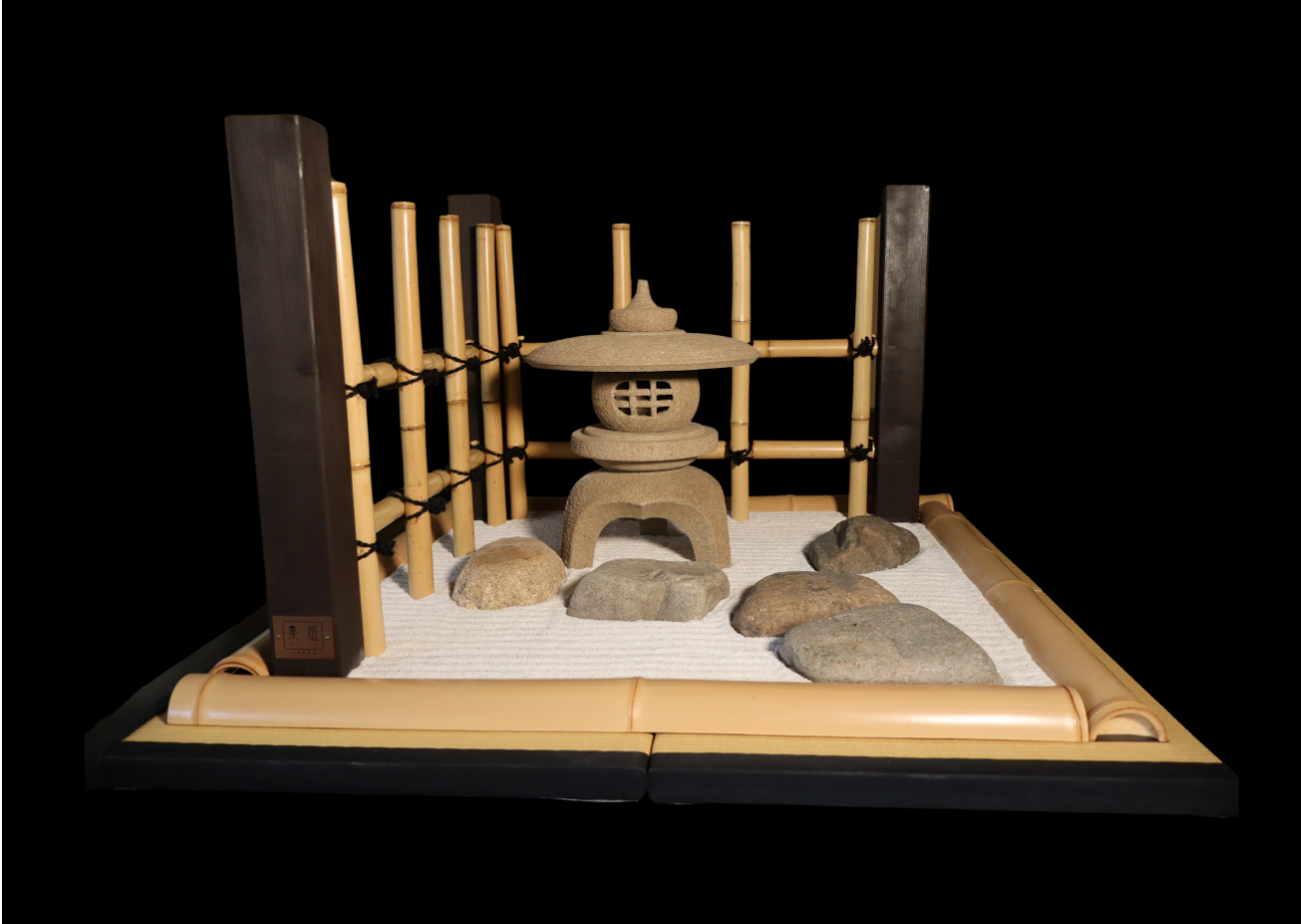
Look closely at a Japanese dry landscape garden and you will notice that the white gravel is never simply scattered. It is combed into fine parallel lines, gentle waves and rings that circle each stone. These patterns are called samon (砂紋), literally “sand patterns,” and they are one of the quietest yet most expressive arts of the Japanese garden.
In this article, we explain what raked gravel patterns mean, the most common designs, and how you can enjoy the practice of raking at home — even without a large garden.
What is samon?
Samon are the lines drawn into gravel or sand with a wooden or metal rake. They appear most often in karesansui (枯山水), the dry landscape style closely associated with Zen temples. In a karesansui garden there is no actual water. Instead, white gravel represents the sea, a river or a lake, and stones represent islands and mountains. The raked lines give that “water” movement: the stillness of a calm sea, the flow of a stream, or ripples spreading outward from an island.
Because the patterns slowly soften with wind, rain and fallen leaves, they must be raked again and again. Samon are never finished; they are renewed. This is part of their beauty.
The meaning behind the patterns
There is no single fixed rulebook for samon, and each garden and gardener has its own style. Still, several patterns are widely used, and each carries its own image:
- Straight lines — a calm, open sea or a still surface of water. Straight parallel lines create a sense of order and quiet, and they make the stones placed in the gravel stand out.
- Rings around stones — ripples spreading around an island. Circles drawn around a rock connect the stone and the “water,” so that each stone seems to rise naturally from the sea.
- Waves (seigaiha and similar patterns) — the rhythm of waves. Overlapping arcs, like the traditional seigaiha (青海波) motif, suggest an endless, peaceful sea and are also a symbol of good fortune in Japanese design.
- Flowing curves — a stream or river. Long, winding lines guide the eye through the garden, as if water were running between the stones.
Combining these patterns turns a small area of gravel into a whole landscape. The viewer’s imagination fills in the rest — and that space for imagination is at the heart of the dry landscape garden.
Raking as a practice of the mind
In Zen temples, caring for the garden is part of daily practice. Drawing a line in the gravel requires attention to the present moment: the angle of the rake, the depth of each groove, the distance from the stone. When the mind wanders, the line wavers. Many people find that raking gravel, even for a few minutes, calms the mind and brings a sense of peace.
This is why samon are loved not only by those who look at gardens, but by those who make them. The act of raking is itself a quiet ritual.
How to rake gravel patterns: basic steps
- Level the gravel. First, smooth the surface so the depth is even. Remove leaves and debris.
- Draw the rings first. Start with the circles around each stone, working from the stone outward.
- Fill in the open areas. Draw straight lines or waves across the remaining space, joining them gently to the rings.
- Move slowly and steadily. Walk backward as you rake so you do not step on the finished lines.
- Redraw when needed. When the pattern blurs, level the gravel and begin again. Changing the pattern with the seasons is part of the enjoyment.
Enjoy samon at home with RAKUTEI
You do not need a temple garden to enjoy raking. RAKUTEI is a modular Japanese garden from Izumo, Japan, made with genuine landscape stones, bamboo fences and white gravel, designed to be placed indoors or outdoors — in a living room, a shop, a restaurant or a hotel lobby.
RAKUTEI comes with tools made exclusively for it. The Sand Crest Drawing tool, made of polished stainless steel, has a straight edge to flatten the gravel and a wavy edge to draw wave patterns. The Gravel Plow helps you spread and gather the white gravel. With these, anyone can draw samon in their own small garden and redraw them whenever they like.
For a dry landscape garden inspired by Izumo, the land where, according to tradition, the gods of Japan gather each year, see RAKUTEI “Kamiari”.
Frequently asked questions
What are the lines in a Zen garden called?
They are called samon (砂紋), meaning “sand patterns.” They are drawn with a rake in the gravel or sand of a dry landscape garden (karesansui).
What do the circles around the rocks mean?
They represent ripples spreading around an island in the sea. They visually connect the stone to the gravel “water” around it.
Can I make a Zen garden indoors?
Yes. A tabletop or modular garden lets you enjoy stones, gravel and raking indoors. RAKUTEI is designed for this, and its carry-bag model assembles in about 20 minutes with no special tools.
Do you ship RAKUTEI outside Japan?
Yes. For customers outside Japan, packing and international shipping are charged separately, and we send the details and a quote by email. Please contact us at rakutei@takezofarm.co.jp.
Ne|Wa is the garden-art brand of Takeda Landscaping Co., Ltd., a landscaping company in Izumo, Shimane, founded in 1984.
