


In the Japanese garden, there is a technique for depicting a waterfall without using a single drop of water. It is called taki-ishigumi, the “waterfall stone arrangement.” Through the shape, orientation and grouping of stones, it evokes the force of falling water and even its sound—an expression unique to the Japanese garden. In this article, we introduce the highlights of taki-ishigumi and the waterfall scene captured in Rakutei’s Toooro Bonsai.
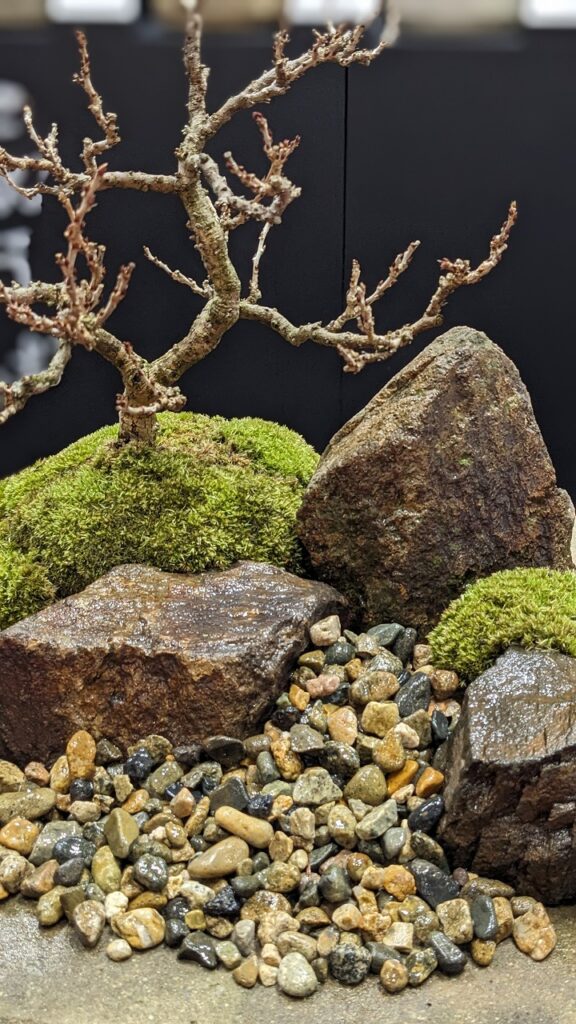
1. Painting a Waterfall with Stone
Waterfalls in Japanese gardens take two forms: those where real water falls, and kare-daki, “dry waterfalls,” expressed with stones alone. In a karesansui (dry landscape) garden, a tall stone stands for the lip of the falls, and sand or gravel laid beneath it represents the water flowing out. Viewers imagine the movement of water within the layered stones and sense the presence of a waterfall in the stillness of the garden.
When a waterfall is placed at the back of a garden or on higher ground, it creates a sense of depth, as though water were flowing toward the viewer. Taki-ishigumi also plays an important role in giving direction to the flow of the entire garden.
2. The Basic Form of Taki-ishigumi
In taki-ishigumi, the central stone, representing the face over which the water falls, is called the mizuochi-ishi (“water-falling stone”). Stones are set on either side of it to shape the waterfall. By varying their height and angle, the falls can appear powerful and grand, or slender and quiet. The stream of gravel leading from the mouth of the falls represents the path of water that eventually flows into a pond or river.
The streaks and cracks on a stone’s surface may also be read as the flow of water. The texture of stones weathered over long years lends the feeling that water has truly been running over them all along.
3. The Waterfall Scene in Toooro Bonsai
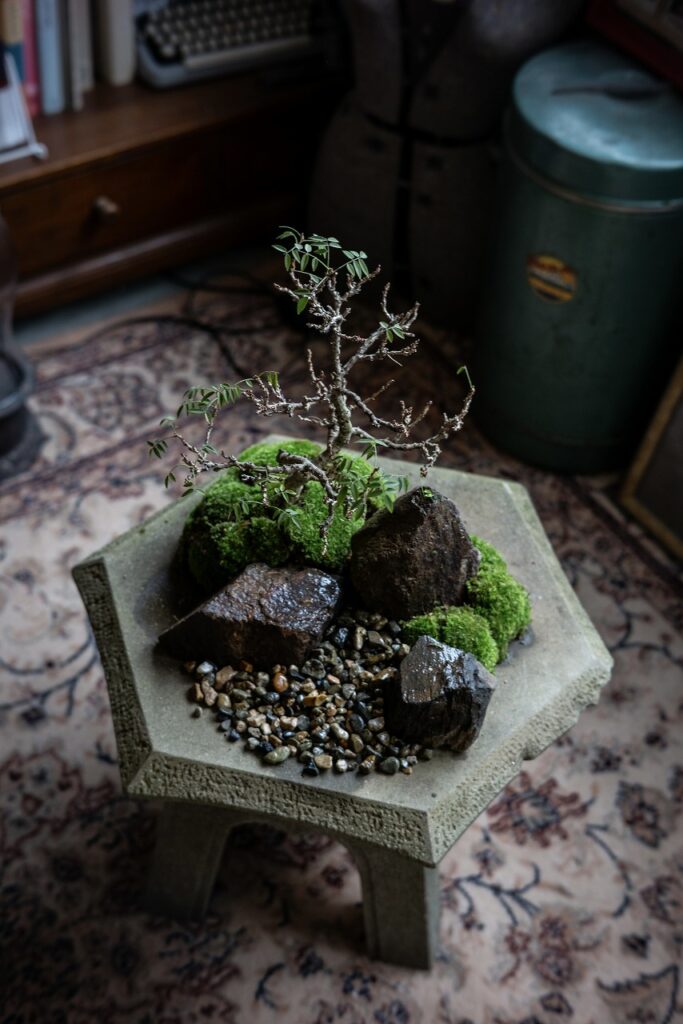
Rakutei’s Toooro Bonsai (Yukimi Bonsai) combines a genuine yukimi-doro (snow-viewing stone lantern) with bonsai. Three rocks are arranged to evoke a waterfall, and river gravel expresses the flow of water in this karesansui composition. A yamafuji (Japanese wild wisteria) planted beside the falls gives the scene depth, while green moss gently softens the character of the stones. The lantern is an authentic stone lantern once used in a Japanese garden, and its surface retains the weathering and moss of many years.
The joy of growing bonsai, the joy of displaying it as an interior piece, and the joy of experiencing Japanese culture—you can savor all three in a single work.
Taki-ishigumi is a piece of Japanese garden wisdom that invites us to imagine unseen water through stone and empty space. To feel a flowing waterfall in silence, without the sound of water—why not enjoy this distinctly Japanese sense of beauty, close at hand, in your own room?
